
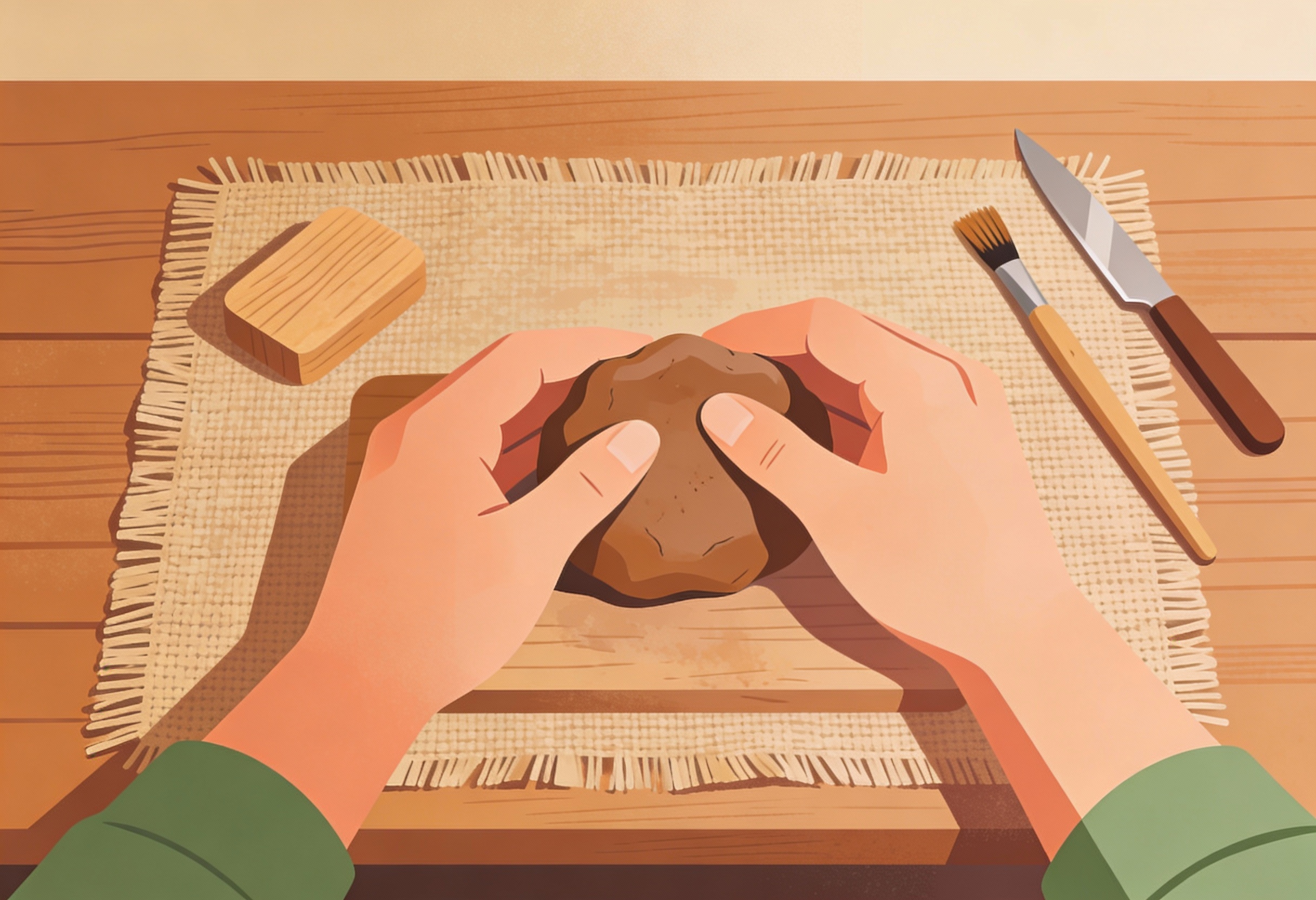
There is something immediately different about handmade objects, even before you understand what they are or how they were made. The difference doesn’t shout. It doesn’t rely on branding or explanation. It sits quietly in the background and waits for you to notice it on your own.
In a world shaped by speed and replication, handmade work introduces friction in the best possible way. It slows the moment down. It asks you to look a little longer, to feel a little more. Not because it is demanding attention, but because it carries traces of time, intention, and human presence that mass production tends to smooth out.
That subtle shift in feeling is not accidental. It is the result of hands making decisions in real time.
The Human Pace Behind Handmade Work
Handmade pieces move at a different pace from the moment they are created. There is no conveyor belt urgency, no pressure to be identical to the last one. Each step depends on judgment, adjustment, and feel.
This human pace leaves marks. Small variations in texture, shape, or finish are not flaws. They are evidence. Proof that something was shaped rather than processed. When you encounter a handmade object, you are not just seeing an outcome. You are sensing the process that led there.
That process carries patience. It carries pauses. And those pauses are felt by the person who eventually holds the finished piece.
Why Imperfection Feels More Honest
Mass-produced objects are designed to erase difference. Handmade objects accept it. That acceptance changes how we relate to them.
When something is not perfectly uniform, it feels more approachable. There is less distance between the maker and the user. Slight irregularities remind us that human work is adaptive, not fixed. Responsive, not rigid.
This honesty builds trust. Not the kind that needs explanation, but the kind that settles in quietly. You are less afraid to use something handmade. Less worried about preserving a flawless surface. It feels meant to be lived with, not protected from life.
Craft as a Container for Values
Craft is often discussed as skill, but it is just as much about values. What is prioritized. What is allowed to take time. What is worth doing slowly.
When a maker chooses materials carefully, or refuses to rush a process, that decision becomes part of the final object. Handmade work carries these choices forward. It becomes a container for values that are otherwise hard to see.
This is why handmade items often feel grounded. They reflect restraint as much as creativity. Attention as much as expression. You can sense when something was made with care rather than efficiency.
The Emotional Weight of Human Touch
Touch matters. Not just in how something feels physically, but in how it registers emotionally. Handmade objects tend to invite touch without instruction. You want to run your fingers along a surface. You want to hold it a moment longer.
This response is not about nostalgia. It is about recognition. The body recognizes the logic of another body’s work. The weight feels considered. The balance feels intentional. Even without knowing the maker, you feel their presence.
That presence creates connection. And connection changes how objects are valued over time.
Why Handmade Objects Age Differently
One of the quiet strengths of handmade work is how it ages. Wear does not erase its character. It adds to it.
Because handmade objects are already marked by process, additional marks feel like continuation rather than damage. Use becomes part of the story instead of something to hide. The object evolves alongside the person using it.
This shared timeline builds attachment. Handmade items are less likely to be discarded because they feel personal. Not replaceable. They carry memory.
Craft in a Culture of Speed
Modern culture rewards speed, scalability, and convenience. Handmade work exists slightly outside that system. Not in opposition, but in contrast.
It reminds us that not everything needs to be optimized. Some things benefit from resistance. From taking longer than expected. From requiring attention rather than bypassing it.
Handmade craft offers a different definition of value. One based on presence instead of output. On care instead of volume.
When Objects Feel Personal Without Being Custom
Not every handmade piece is made specifically for one person. Yet many still feel personal. This is the quiet paradox of craft.
Because the work carries human decision-making, it feels relational even when anonymous. You feel like someone was there. Making choices. Responding to material. Taking responsibility for the outcome.
That sense of responsibility transfers. You treat the object differently. You keep it longer. You notice it more.
Why Handmade Continues to Matter
Handmade work persists not because it is rare, but because it fulfills something modern systems often overlook. The need for connection, slowness, and tangible meaning.
In everyday life, handmade objects quietly recalibrate expectations. They remind us that value does not always come from perfection or speed. Sometimes it comes from attention held long enough to leave a trace.
That is the different feel handmade carries. Not louder. Not better. Just deeper.